 Conectar
 |
|
Description:
Length / Продолжительность: 00:21:02
Tracks / Треклист:
01 - Astral Divination
02 - Organic Monolith
03 - In Spaces Beyond
04 - Realm of Ichor
Encyclopaedia Metallum
Download Infected Dead - Invicta (EP)
|
|
Download Infected Dead - Invicta (EP) |
|
Line-up: Download Aurora Borealis - Discography (1996 - 2026) (Lossless) |
|
Download Necrotesque - Discography (2021 - 2026) (Lossless) |
|
Download Power Paladin - Discography (2022 - 2026) (Lossless)
Dan Frazier, one of the original artists for Magic: The Gathering, has been wrapped up in a plagiarism scandal this month over a recently released image of the One Ring from The Hobbit set. Fans on Reddit quickly noticed that Frazier's image greatly resembled a previous One Ring illustration by Marta Nael from the Tales of Middle-earth set. Now, Frazier and Magic: The Gathering's parent company, Wizards of the Coast, have acknowledged that Nael's art was used without her permission or credit for her work.
"I made a mistake, and I feel awful," wrote Frazier in a statement on X. "I especially feel for Marta, whose work I adore. In trying to create an iconic version of The One Ring, while looking at references online, I ended up using Marta's Ring as a reference and painted over it to try to depict the item the fans hold dear to their hearts. In doing so, I didn't make it my own. I'm reaching out to Marta privately to apologize artist to artist."
A message from Dan Frazier and Wizards of the Coast: pic.twitter.com/4VCM8avcay
— Magic: The Gathering (@wizards_magic) May 2, 2026
Wizards of the Coast's message stated that it has plans to pay Nael for her work and that both she and Frazier will be credited for the art in the digital versions. The company's statement also noted that it didn't catch the similarities between the two works before adding, "We still value Dan and his contributions and are grateful for his place in the game."
Continue Reading at GameSpot

With rumors swirling that Kingdom Come developer Warhorse is developing a new The Lord of the Rings RPG, actor Tom McKay--who plays main character Henry in the Kingdom Come series--has commented on which The Lord of the Rings character he would like to play in a hypothetical game.
He told Radio Times that The Lord of the Rings is filled with "incredibly rich, complex characters," but if he had to choose one, it would be a character with Aragorn vibes. He also said, should he be cast in a Lord of the Rings game, he would want his character to differ from Henry.
"If I were to do it, and I flatter to think that anybody would want me to do it, I'd probably rather nudge it away from the Henry vibes a little bit. I quite like playing a sort of broad palette of characters," he said.
Continue Reading at GameSpot
One of the biggest banks in the world, Bank of America, said in a new investor note that it believes Take-Two should price GTA 6 at $80 to help drive prices higher across the industry. This is happening against a backdrop where games are getting more and more expensive to make.
The bank attended the recent iicon event in Las Vegas, where Take-Two boss Strauss Zelnick discussed GTA 6's pricing at a high level, and said in its note that GTA 6 should be the game that kicks off a new trend of $80 games across the board. Omar Dessouky, the Bank of America securities stock analyst who wrote the note, said he heard from attendees at the event that the video game business is struggling.
He said the industry overall would struggle to sell games for $80 if one of the most anticipated games ever--GTA 6--comes out at $70. And given that, he said, "We think it's in Take-Two's self-interest, as a publisher and partner to many developers, to raise the price point for the entire industry," according to Seeking Alpha.
Continue Reading at GameSpot
One of Walt Disney World's most popular attractions, Big Thunder Mountain Railroad, reopened on May 3 after about 1.5 years of downtime for refurbishments and upgrades. The reopening did not go entirely to plan, as cast members had to use a fire extinguisher on the Magic Kingdom ride to deal with an issue, prompting an evacuation of guests and the ride to close temporarily as the issue was addressed.
A parkgoer posted a photo on social media showing a cast member using a fire extinguisher on the ride's tracks, with a white substance covering the area. Whether or not there was an actual fire is unknown. The incident happened around 5:45 PM and the ride later reopened.
No injuries were reported, and Disney has not commented on the mishap.
Continue Reading at GameSpot
The latest chapter in video game retailer GameStop's tumultuous story is unfolding, as the company has announced plans to make a deal to buy eBay for $55.5 billion.
GameStop said in a news release that it submitted a "non-binding proposal" to buy 100% of eBay at $125 per share in cash and stock, at 50% each. This would be about a 20% premium over where eBay's stock was trading on Friday and a 46% premium to eBay's closing price on February 4 this year. That was the day that GameStop started buying eBay stock. Today, it owns about 5% of eBay's outstanding stock.
CEO Ryan Cohen told The Wall Street Journal, "There is nobody who is more qualified, based on my experience, to run the eBay business," he said.
Continue Reading at GameSpot
Leaded fuel is considered one of the greatest environmental failures in modern human history. Adding tetraethyl lead to gasoline reduced knock in internal combustion engines, which was widely considered a good thing. It was only later that the deleterious health effects came into view, by which point there was a massive fleet of lead-dependent automobiles and an industry reluctant to change. Still, the tide turned, and over the last 50 years, unleaded fuel has become the norm for automotive use across the world.
And yet, there remains a hold out—a world where engines still burn leaded fuels and spray their noxious fumes across the countryside. In the aviation sector, leaded fuel remains a normal part of everyday operations to this day amidst concerted efforts to eliminate it for good.
Piston-engined aircraft do not typically run on the same fuels as automobiles. Instead, they burn aviation gasoline, or Avgas, which comes in specific grades and is designed to suit the needs of aircraft engines, by being less volatile and more suitable for high-performance applications.
The most common grade is 100LL (low lead), which is used widely across North America and Western Europe. Despite the moniker, the fuel contains 0.56 grams/litre of tetraethyl lead (TEL), somewhat higher than many leaded automotive fuels used in the 20th century. As with ground-based applications, the additive is used to provide a measure of valvetrain protection by offering cooling and preventing microwelds between contacting parts. It also provides an easy increase to the fuel’s effective octane rating. The latter is particularly useful in aviation contexts where engines run under high load conditions for extended periods of time, and where performance is critical.
Other grades of aviation fuel are also in regular use in various parts of the world, many of which still contain significant levels of TEL as well. It’s worth noting that turbine-based aviation engines are not relevant to this issue, as they burn kerosene-based fuels which are lead-free.
The basic makeup of aviation gasoline was largely decided by the mid-1940s, a period in which fuels were heavily developed to suit the needs of then-cutting-edge piston military aircraft. At the time, knock resistance was key to enabling supercharged aircraft engines to achieve higher power levels, a point of key military interest during World War II. Tetraethyl lead was an easy way to achieve this, and this requirement also led to development of technologies like water-methanol injection.
Unfortunately, burning leaded fuel effectively sprayed significant amounts of lead into the environment. This lead to elevated blood lead levels in the population, causing premature deaths, neurological damage, and negatively impacting development in children. This is perhaps somewhat galling given that the inventor of TEL, Thomas Midgley Jr., himself suffered significant health effects from the compound. Many workers would also die during early efforts to produce industrial amounts of TEL in the 1920s. It’s one of many examples from the 20th century of industrial will prevailing in spite of obvious severe health risks from a dangerous but otherwise useful chemical.
Despite early knowledge of the dangers, it took some time for the negative impacts of TEL to become readily apparent on a wide scale. Japan lead the charge with a leaded fuel ban for automotive use in 1986, with other developed countries following suit in years to come. It would take decades for the last domino to fall, with Algeria finally outlawing the fuel in 2021.
However, the aviation world has not been so quick to abandon lead. Much of the reasoning behind this comes down to practicality. Aviation piston engines simply require high octane fuel and TEL has proven one of the easiest ways to achieve a high rating. 100LL, for example, has a MON rating of 100, which is quite high compared to even premium gasoline used in automotive applications.
Engines designed to run on TEL often rely on the additive to prevent excessive valve wear, too, so running these engines on non-leaded fuels can significantly increase wear. This would be an expensive inconvenience in an automotive application, but when the engine is what’s keeping you in the sky, it’s less desirable to risk a failure by running a cleaner fuel.
In 2019, the FAA estimated that there were 167,000 aircraft in the United States that relied on 100LL avgas, and 230,000 worldwide. The agency had asked in 2014 for industry proposals to make a transition towards unleaded fuels for internal combustion applications.
However, testing revealed issues with proposed alternatives, and was eventually halted in 2018. The FAA has since provided a draft plan in 2026 that lays out the timeline to phase out leaded aviation fuel for good. The intent is to end the use of 100LL fuel in the United States by 2030, excepting Alaska, which will phase out the fuel in 2032. The intention is to take an incremental approach, giving the industry time to develop and certify unleaded replacement fuels—with G100UL, 100R, and UL100E all candidates for FAA approval.
Real-world use of these fuels will then be monitored for compatibility and safety and to determine if further support or changes are required to manage the transition away from 100LL. For now, the timelines are still subject to change, particularly in Alaska, where piston-engined aircraft are particularly vital for transport and logistics are harder to manage. However, it marks a very real commitment to ending the use of leaded aviation for good, at least in the United States. If the FAA does manage to pull off this feat, it should be readily achievable for other countries around the world.
Ultimately, leaded aviation fuels aren’t causing the same level of damage to humanity and the environment as leaded automotive fuels, purely by virtue of their more limited use. Still, it’s never ideal to be spraying lead into the environment, and the health risks are always going to be elevated for those near general aviation airports or under flightpaths of piston-engined aircraft. It’s positive that there is a real commitment to end the use of these fuels, but much work remains to be done to end the reign of tetraethyl lead for good.
Featured Image: “Tetraethyl Lead” by [David Brodbeck]
Was there ever anything wrong with simple paper price labels? Absolutely not. And yet, the world invented the electronic price tag anyway. If you happen to come across some of these devices and want to hack them, you might like TagTinker from [i12bp8].
TagTinker is a Flipper Zero application specifically built for talking to infrared electronic shelf labels (ESLs). These are e-paper devices that receive commands and updates via an infrared interface, and they’re relatively simple to talk to. [i12bp8] built upon previous work from [furrtek] which revealed the protocols used to update these devices, and implemented it into an app that runs on the Flipper. It can do neat things like scan the NFC tags built into ESLs to ID them, deploy bitmap images to the tags, or run live-updated dashboards on the devices with the aid of a Flipper WiFi devboard.
If you’ve always wanted to play with these tags but didn’t want to do the grunt work yourself, it just got a whole lot easier to mess around. Though, it’s worth noting, [i12bp8] has strictly prohibited any illegal uses of this app, so be good out there. We’ve seen these tags repurposed before, too – who knew they could make such good conference badges?
A time domain reflectometer (TDR) is a useful tool to have for finding faults in a wiring harness. However, they don’t come cheap, putting them out of reach for many shadetree mechanics that like to work on their own cars. However, [László SZŐKE] has been exploring a neat way to build a similar device on the cheap.
Typically, time domain reflectometry involves shooting a short electric pulse down a wire, and listening for how long it takes to bounce back. The time depends on the length of the wire, so it can be used to determine the location of a break in conductivity. Unfortunately, these pulses move so fast that very fast, very expensive hardware is needed to make these measurements.
[László’s] technique relies on lower-tech hardware. Instead of sending a very short pulse down a wire, his rig uses a cheap C-Media USB audio device to send a 4 kHz or 8 kHz sine wave instead. Then, by listening to the reflection and measuring the phase shift, it’s possible to detect the distance to the end of the wire (or a break along its length). Some supporting hardware is required for protection’s sake, and to tune the setup for measuring shorter or longer cabling. However, with some smart software processing, [László] states that it’s possible to measure down to 1 cm resolution.
The idea is that this setup could prove particularly useful for automotive troubleshooting. If you measure a wire and the device reports a length of 30 cm, when you know the wire stretches several meters into the engine bay… you know there’s a break around 30 cm from your measurement point.
There’s still plenty of work to be done – for now, [László] is working on a new prototype that should have better performance when testing shorter cables. Still, we love to see this sort of out-of-the-box thinking put towards a common troubleshooting task. If you’re doing fun signal analysis work of your own, don’t hesitate to light up the tipsline.
Although modern cameras can, with skill and good conditions, produce photographs nearly indistinguishable from the original scene, this fidelity relies on the limitations of human vision. According to the trichromatic theory, humans perceive light as a mixture of three colors, which can be recorded and represented by cameras, displays, and color printing; a spectrometer, however, can detect a clear distance between the three colors present in a photograph and the wide range of spectra in the original scene. By contrast, one of the earliest color photography methods, Lippmann plates, captured not just true color, but true spectra.
A Lippmann plate, as [Jon Hilty] details, starts with a layer of photographic gel containing extremely fine silver halide crystals over the back of a glass plate. This layer is placed on top of a mirror, traditionally a mercury bath, and put in the camera. When light passes through the emulsion and reflects off the mirror, it interferes with incoming light to create a standing wave. The portions of the emulsion at the wave’s antinodes absorb the most energy, converting local silver halide crystals into reflective silver. The spacing of the silver particles depends on the incoming light’s wavelength, and is fixed in place during the development process.
This creates a matrix of vertically-stacked diffraction gratings, each diffracting back the original wavelength when illuminated with white light. Unlike normal diffraction gratings, the wavelength of diffracted light doesn’t depend strongly on the viewing angle; since the interference structure here is vertically-arranged, it refracts a narrow range of wavelengths across all possible viewing angles. The viewing angles, however, are limited; unlike with dye-based photographs, you can only view the colors nearly straight-on. This, along with the necessity for long exposures, the chance of producing washed-out colors, and the impossibility of creating reprints, kept Lippmann plates from ever really catching on. The basic concept lives on in holograms, which encode spatial information in a similar kind of photographically-formed diffraction pattern.
For a more conventional method of color photography, we’ve also seen a recreation of the autochrome method. Alternatively, check out this homemade silver halide photography emulsion.
Thanks to [Stephen Walters] for the tip!
Although the ReactOS project is in no rush to dethrone Windows as the desktop operating system of choice, this doesn’t mean that some real changes aren’t happening. Most recently two big changes got merged, the first pertaining to the separate boot- and live CD images that are now merged into a single image, and the second being a new PnP-aware ATA storage stack for ATA and AHCI devices, with NT6+ compatibility.
Although there is still a separate live CD for now, this first change means that testing and installing ReactOS becomes easier, and that the old-school text-based installer may soon be on its way out as well.
Having the new ATA storage stack in place will translate into much better compatibility with real hardware, including the ability to use more hardware to install on and boot from compared to the old UniATA driver.
Combined, these two changes should bring the ReactOS installation and usage experience a lot closer to that of Windows, as well as many Linux distros. If you had issues with the OS on real hardware, this might be just the right time to give it another shake and provide detailed feedback to the developers if any remaining issues are encountered.
Thanks to [jeditobe] for the tip.
Software that collects public data from the Internet and uses it to provide half-assed answers to your questions might seem like a modern craze, but today we bid farewell to a website that helped pioneer pretend conversations all the way back in 1997 — as of May 1st, Ask Jeeves is no more.
Well, technically they dropped the “Jeeves” part back in 2006. Since then it’s just been Ask.com, but as the name implies the idea was more or less the same. Rather than the relatively rigid parameters and keywords required by traditional search engines, you could ask Jeeves questions about the world using natural language. Early advertisements showed the virtual valet answering arbitrary questions like “How many calories in a banana?,” which of course today seems commonplace and utterly unimpressive, but was a pretty wild for the 1990s.
It might seem surprising that a site designed from day one to offer a human-like Q&A experience should fold right as such technology is becoming commonplace. But of course, that commonality is the problem. When Google can answer your questions just as well (or poorly…) as Jeeves or anyone else, what’s the benefit for the average Internet user to seek out another service? But it’s still somewhat ironic, which is probably why the farewell message on Ask.com ends with the line “Jeeves’ spirit endures.”

While on the subject of technology that’s potentially ahead of its time, MacRumors is reporting that Apple is giving up on their Vision Pro augmented reality googles. They haven’t been formally discontinued as of yet, but sources indicate that the internal development team for the entire product line has been disbanded and reassigned to other projects within the company. This comes after a October 2025 refresh of the hardware still failed to connect with consumers. Insiders have said that not only were sales sluggish on the ~$3,500 headsets, but that they were getting returned at a far higher rate than any of Apple’s other hardware products.
Now, we’re hardly Apple apologists here at Hackaday. It sort of goes without saying that the whole “Walled Garden” thing doesn’t really fit our ethos. But we can’t deny that the Vision Pro is an impressive piece of technology. After years of sticking our phones in crappy plastic headsets, or trying to force hardware designed for VR gaming to do literally anything else, the Vision Pro offered a practical way to put augmented reality to work. But even for a company known for producing expensive hardware, the price tag was just too much for most consumers.
We’ll go out on a limb here and predict that the Vision Pro will one day be looked back on like the Newton — a product that was too expensive and niche to be a commercial success when it came out, but still a technical milestone that gave us a glimpse into the shape of things to come.
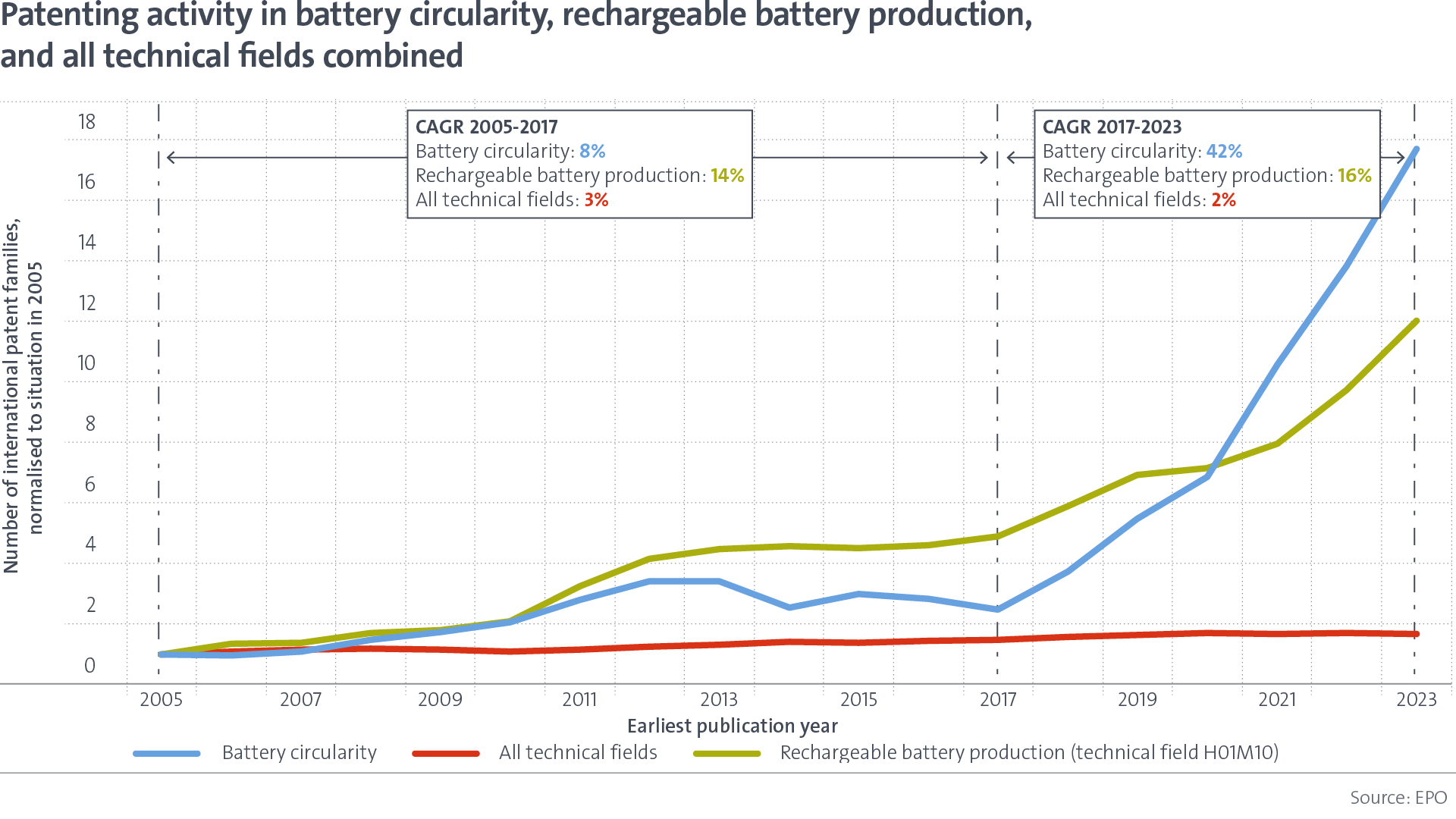
Speaking of a technology that will inevitably become more common, the European Patent Office (EPO) released a report this week showing a seven-fold increase in the number of inventions intended for battery reuse and recycling over the last decade. Given our insatiable demand for rechargeable batteries, it should come as no surprise that there’s a huge push for new methods of squeezing more use out of cells. As noted several times by the EPO, it’s not purely about saving money either. Even if Europe produces the batteries domestically, they need to import the raw materials. Relying on foreign countries to provide critical infrastructure can be precarious in the best of times, and is likely to only become more politically onerous in the future.
Finally, we’ll leave you with a fun way to waste some time on a Sunday evening: Visible Zorker. Created by Andrew Plotkin, this website allows you to not only play through all three installments of Zork, but presents a debugger-style view of the source code as the game is running. Even if you’re not terribly interested in seeing how your responses are parsed, the map that shows your progress through the world is certainly handy. The project was actually started back in 2025, but Andrew just completed the trilogy by adding support for Zork III a couple days ago so now is the perfect time to check it out.
See something interesting that you think would be a good fit for our weekly Links column? Drop us a line, we’d love to hear about it.
Triple monitor workstations are pretty common these days, particularly for those wishing to maximise screen space for greater productivity. [Will It Work?] has put together a sillier take on this concept, however, hooking the diminutive iPod Nano up to three monitors instead.
The 6th-generation iPod nano brought forth a new form factor – it’s the postage stamp-sized one that you could clip to your workout gear. It’s not typically what you’d call a productivity device, but there is a way to get more out of it. The trick is to grab a 30-pin Keyboard Dock, which allows access to the composite video signal from the iPod. It was originally designed for the iPad, but it works with the iPad nano too with a 30-pin spacer adapter – just don’t expect the keys to do anything. This setup also allows access to the 3.5mm four-pole jack, which handles audio input and output. With a bunch of additional cables and adapters, the iPod was able to be hooked up to three screens, a set of Apple Pro speakers, and three Sharp LCD monitors.
What can you do with this setup? Fundamentally, not a whole lot. You can’t use the keyboard with the iPod Nano, so you’re limited to interacting with the tiny touchscreen. There also aren’t exactly a lot of apps to run on the platform, either. You can basically listen to music, watch a slide show, or record voice memos, while looking at the iPod’s display spread identically across three TVs. Still, it’s a fun joke build, because at a glance it genuinely looks like you’ve set up a triple-monitor workstation running off a tiny iPod from over a decade ago.
If you want to blow the mind of your next podcast guest, consider recording your next episode on this rig. Alternatively, explore some of the other hacks we’ve seen for the platform. Video after the break.
