Vista Normal

Hay nuevos artículos disponibles. Pincha para refrescar la página.
Ayer — 4 Mayo 2026Salida Principal

Why Leaded Fuel Is Still A Thing

4 Mayo 2026 at 14:00

Leaded fuel is considered one of the greatest environmental failures in modern human history. Adding tetraethyl lead to gasoline reduced knock in internal combustion engines, which was widely considered a good thing. It was only later that the deleterious health effects came into view, by which point there was a massive fleet of lead-dependent automobiles and an industry reluctant to change. Still, the tide turned, and over the last 50 years, unleaded fuel has become the norm for automotive use across the world.

And yet, there remains a hold out—a world where engines still burn leaded fuels and spray their noxious fumes across the countryside. In the aviation sector, leaded fuel remains a normal part of everyday operations to this day amidst concerted efforts to eliminate it for good.

“Low” Lead

Leaded gasoline is a thing of the past in the automotive world, but remains a standard fuel for piston-engined aircraft to this day. Credit: Ahunt, public domain

Piston-engined aircraft do not typically run on the same fuels as automobiles. Instead, they burn aviation gasoline, or Avgas, which comes in specific grades and is designed to suit the needs of aircraft engines, by being less volatile and more suitable for high-performance applications.

The most common grade is 100LL (low lead), which is used widely across North America and Western Europe. Despite the moniker, the fuel contains 0.56 grams/litre of tetraethyl lead (TEL), somewhat higher than many leaded automotive fuels used in the 20th century. As with ground-based applications, the additive is used to provide a measure of valvetrain protection by offering cooling and preventing microwelds between contacting parts. It also provides an easy increase to the fuel’s effective octane rating. The latter is particularly useful in aviation contexts where engines run under high load conditions for extended periods of time, and where performance is critical.

Other grades of aviation fuel are also in regular use in various parts of the world, many of which still contain significant levels of TEL as well. It’s worth noting that turbine-based aviation engines are not relevant to this issue, as they burn kerosene-based fuels which are lead-free.

100LL fuel is dyed blue for easy identification on the flight line. It’s one of the most widely used fuels in piston-engined aircraft. Credit: Ahunt, public domain

The basic makeup of aviation gasoline was largely decided by the mid-1940s, a period in which fuels were heavily developed to suit the needs of then-cutting-edge piston military aircraft. At the time, knock resistance was key to enabling supercharged aircraft engines to achieve higher power levels, a point of key military interest during World War II. Tetraethyl lead was an easy way to achieve this, and this requirement also led to development of technologies like water-methanol injection.

Unfortunately, burning leaded fuel effectively sprayed significant amounts of lead into the environment. This lead to elevated blood lead levels in the population, causing premature deaths, neurological damage, and negatively impacting development in children. This is perhaps somewhat galling given that the inventor of TEL, Thomas Midgley Jr., himself suffered significant health effects from the compound. Many workers would also die during early efforts to produce industrial amounts of TEL in the 1920s. It’s one of many examples from the 20th century of industrial will prevailing in spite of obvious severe health risks from a dangerous but otherwise useful chemical.

Despite early knowledge of the dangers, it took some time for the negative impacts of TEL to become readily apparent on a wide scale. Japan lead the charge with a leaded fuel ban for automotive use in 1986, with other developed countries following suit in years to come. It would take decades for the last domino to fall, with Algeria finally outlawing the fuel in 2021.

As per the MSDS, 100LL fuel is not good for humans or the environment. Credit: Shell MSDS

However, the aviation world has not been so quick to abandon lead. Much of the reasoning behind this comes down to practicality. Aviation piston engines simply require high octane fuel and TEL has proven one of the easiest ways to achieve a high rating. 100LL, for example, has a MON rating of 100, which is quite high compared to even premium gasoline used in automotive applications.

Engines designed to run on TEL often rely on the additive to prevent excessive valve wear, too, so running these engines on non-leaded fuels can significantly increase wear. This would be an expensive inconvenience in an automotive application, but when the engine is what’s keeping you in the sky, it’s less desirable to risk a failure by running a cleaner fuel.

In 2019, the FAA estimated that there were 167,000 aircraft in the United States that relied on 100LL avgas, and 230,000 worldwide. The agency had asked in 2014 for industry proposals to make a transition towards unleaded fuels for internal combustion applications.

However, testing revealed issues with proposed alternatives, and was eventually halted in 2018. The FAA has since provided a draft plan in 2026 that lays out the timeline to phase out leaded aviation fuel for good. The intent is to end the use of 100LL fuel in the United States by 2030, excepting Alaska, which will phase out the fuel in 2032. The intention is to take an incremental approach, giving the industry time to develop and certify unleaded replacement fuels—with G100UL, 100R, and UL100E all candidates for FAA approval.

Real-world use of these fuels will then be monitored for compatibility and safety and to determine if further support or changes are required to manage the transition away from 100LL. For now, the timelines are still subject to change, particularly in Alaska, where piston-engined aircraft are particularly vital for transport and logistics are harder to manage. However, it marks a very real commitment to ending the use of leaded aviation for good, at least in the United States. If the FAA does manage to pull off this feat, it should be readily achievable for other countries around the world.

Ultimately, leaded aviation fuels aren’t causing the same level of damage to humanity and the environment as leaded automotive fuels, purely by virtue of their more limited use. Still, it’s never ideal to be spraying lead into the environment, and the health risks are always going to be elevated for those near general aviation airports or under flightpaths of piston-engined aircraft. It’s positive that there is a real commitment to end the use of these fuels, but much work remains to be done to end the reign of tetraethyl lead for good.

Featured Image: “Tetraethyl Lead” by [David Brodbeck]
TagTinker Lets You Hack Electronic Shelf Labels

4 Mayo 2026 at 11:00

Was there ever anything wrong with simple paper price labels? Absolutely not. And yet, the world invented the electronic price tag anyway. If you happen to come across some of these devices and want to hack them, you might like TagTinker from [i12bp8].

TagTinker is a Flipper Zero application specifically built for talking to infrared electronic shelf labels (ESLs). These are e-paper devices that receive commands and updates via an infrared interface, and they’re relatively simple to talk to. [i12bp8] built upon previous work from [furrtek] which revealed the protocols used to update these devices, and implemented it into an app that runs on the Flipper. It can do neat things like scan the NFC tags built into ESLs to ID them, deploy bitmap images to the tags, or run live-updated dashboards on the devices with the aid of a Flipper WiFi devboard.

If you’ve always wanted to play with these tags but didn’t want to do the grunt work yourself, it just got a whole lot easier to mess around. Though, it’s worth noting, [i12bp8] has strictly prohibited any illegal uses of this app, so be good out there. We’ve seen these tags repurposed before, too – who knew they could make such good conference badges? 

TDR For Auto Diagnostics Done On The Cheap

4 Mayo 2026 at 08:00

A time domain reflectometer (TDR) is a useful tool to have for finding faults in a wiring harness. However, they don’t come cheap, putting them out of reach for many shadetree mechanics that like to work on their own cars. However, [László SZŐKE] has been exploring a neat way to build a similar device on the cheap.

Typically, time domain reflectometry involves shooting a short electric pulse down a wire, and listening for how long it takes to bounce back. The time depends on the length of the wire, so it can be used to determine the location of a break in conductivity. Unfortunately, these pulses move so fast that very fast, very expensive hardware is needed to make these measurements.

[László’s] technique relies on lower-tech hardware. Instead of sending a very short pulse down a wire, his rig uses a cheap C-Media USB audio device to send a 4 kHz or 8 kHz sine wave instead. Then, by listening to the reflection and measuring the phase shift, it’s possible to detect the distance to the end of the wire (or a break along its length). Some supporting hardware is required for protection’s sake, and to tune the setup for measuring shorter or longer cabling. However, with some smart software processing, [László] states that it’s possible to measure down to 1 cm resolution.

The idea is that this setup could prove particularly useful for automotive troubleshooting. If you measure a wire and the device reports a length of 30 cm, when you know the wire stretches several meters into the engine bay… you know there’s a break around 30 cm from your measurement point.

There’s still plenty of work to be done – for now, [László] is working on a new prototype that should have better performance when testing shorter cables. Still, we love to see this sort of out-of-the-box thinking put towards a common troubleshooting task. If you’re doing fun signal analysis work of your own, don’t hesitate to light up the tipsline.

iPod Nano Gets Three Monitors

3 Mayo 2026 at 20:00

Triple monitor workstations are pretty common these days, particularly for those wishing to maximise screen space for greater productivity. [Will It Work?] has put together a sillier take on this concept, however, hooking the diminutive iPod Nano up to three monitors instead.

The 6th-generation iPod nano brought forth a new form factor – it’s the postage stamp-sized one that you could clip to your workout gear. It’s not typically what you’d call a productivity device, but there is a way to get more out of it. The trick is to grab a 30-pin Keyboard Dock, which allows access to the composite video signal from the iPod. It was originally designed for the iPad, but it works with the iPad nano too with a 30-pin spacer adapter – just don’t expect the keys to do anything. This setup also allows access to the 3.5mm four-pole jack, which handles audio input and output. With a bunch of additional cables and adapters, the iPod was able to be hooked up to three screens, a set of Apple Pro speakers, and three Sharp LCD monitors.

What can you do with this setup? Fundamentally, not a whole lot. You can’t use the keyboard with the iPod Nano, so you’re limited to interacting with the tiny touchscreen. There also aren’t exactly a lot of apps to run on the platform, either. You can basically listen to music, watch a slide show, or record voice memos, while looking at the iPod’s display spread identically across three TVs. Still, it’s a fun joke build, because at a glance it genuinely looks like you’ve set up a triple-monitor workstation running off a tiny iPod from over a decade ago.

If you want to blow the mind of your next podcast guest, consider recording your next episode on this rig. Alternatively, explore some of the other hacks we’ve seen for the platform. Video after the break.

AnteayerSalida Principal

Photographing The ISS With A Thrift Store Lens Is Challenging

3 Mayo 2026 at 14:00

There are plenty of photos of the International Space Station out there on the Internet, but taking your own from ground level is a special challenge. [saveitforparts] recently decided to attempt this feat using a $15 thrift store lens.

What a setup! The lens is so big it has its own tripod mount.

The cool thing about the digital photography revolution is that there is a lot of old film gear that can be had for cheap. In this case, [saveitforparts] found a 400mm Sigma XQ lens with a 2x teleconverter for just $14.99. Paired with an adapter, it sat nicely on a Sony NEX-3 digital camera, ready to try and capture the ISS as it passed overhead. As you might imagine, aiming at the space station is not a point-and-shoot job. N2YO.com was used to figure out the best time to try and capture it. [saveitforparts] was able to capture the ISS as a white dot as it passed over, but couldn’t quite get enough zoom to really see the ISS in detail.  [saveitforparts] was also able to repeat the feat with a Canon camcorder, too, but the image was still pretty blobby and didn’t show much. Later attempts involved capturing transits as the ISS passed by the Sun, though the ISS mostly appeared as a small speck.

[saveitforparts] did technically capture the ISS, just not closely enough to see much beyond a dot. It’s not the first time we’ve seen this attempted, though! If you try and capture the ISS with something truly ridiculous, like a Game Boy Camera or Kodak Charmera, you are honour-bound to tell us on the tipsline. Video after the break.

A Tool For Testing CANopen Networks

3 Mayo 2026 at 08:00

If you find yourself working with CANopen CC networks, you might find yourself in need of a tool for monitoring what’s happening on the wire. [Michael Fitzmayer] whipped up a piece of software to fulfil just that role. 

CANopenTerm might be named after the CANopen standard, but it’s really a terminal-driven tool for working with CAN buses in general. The software is built for real-time use, allowing sniffing raw frames on the wire, tracing, and probing of nodes, all from within the console. It’s also possible to add scripting via Lua or Python for more advanced work, as well as do protocol-aware inspection if that’s relevant to your use case. The key idea of the software is to be fast and scriptable to suit a given need, rather than bogging everything down with a heavy GUI interface that’s slower to work with.

If you aren’t afraid of getting into the nitty gritty with CAN and like lightweight text-based interfaces, this might be the tool for you. We’ve also explored some other CAN visualization tools lately, as well. Ultimately, there is a lot of machinery out there running on some variant of CAN or other, so it pays to know how to work with it. If you’ve got your own projects cooking up in this space, don’t hesitate to let us know on the tipsline!

Building a C-3PO You Can Really Talk To

3 Mayo 2026 at 05:00

C-3PO is one of the more famous movie robots out there. However, we don’t see a lot of replicas built, perhaps because in speech and mannerisms, he’s quite hard to replicate. Of course, that feat has become much more achievable with modern AI tech, as [Samuel Potozkin] demonstrates.

We’re not looking at a full C-3PO build here, it’s just the head—but for the project’s purposes, that’s all that was really required. The build relies on a Raspberry Pi 5 as the brains of the droid. It’s running a mic hooked up to a real time speech to text engine, and that text is then sent to a large language model for interpretation. Responses are then generated, passed through a processing layer to capture C-3PO’s general tone and vibe, and then handed off to a text-to-speech synth to imitate the iconic voice, played via speaker. The end result is a C-3PO you can actually talk to, which is something that might have knocked a few socks off when the movie first launched in 1977. In-depth materials for the build can be had via Google Drive and on Github.

This ersatz C-3PO isn’t an exact dupe of the movie ‘bot.  The protocol droid is a little slow to respond, and the patter isn’t quite on point, even if the voice synth makes a good effort at mimicking the original. Overall, it’s a little… robotic… something you wouldn’t say of the character in the movies. Still, it’s a great effort, and something we haven’t really seen much of before. If you like more classic droid replicas, though, we’ve featured those too. Video after the break.

Let Twitch Chat Control Your LED Strings

2 Mayo 2026 at 23:00

Once upon a time, someone set up a livestream wherein the messages from Twitch chat could control a game of Pokemon. Since then, we’ve seen Twitch control all sorts of things. If you’d like to have them play with some LEDs in your house, you might like this project from [pfeiffer3000].

The concept is simple enough. The heart of the build is an ESP32 microcontroller, which is easy to integrate with web services thanks to its onboard WiFi capability. It’s hooked upt o a string of WS2812B addressable RGB LEDs. The LEDs themselves are installed within table tennis balls to act as nice, spherical diffusers, and installed in a square frame made of PVC pipes. As for code, the rig uses the WLED library to drive the LED strings, and code from TwitchIO to interface with Twitch chat itself. It’s as simple as rigging up a bit of Python. With everything assembled, [pfeiffer3000] had an attractive LED grid that could be controlled directly by anyone watching their Twitch stream.

We’ve explored how to control things via Twitch before, too. It’s a fun way to add some interactivity to your livestream that really gets viewers involved. If you’ve been building your own audience-controlled projects, we’d love to hear about them on the tipsline!

Rust Helps Make A $1 Handheld Console

2 Mayo 2026 at 05:00

These days, even an old Game Boy will set you back $100 or more, and a new handheld console will be many multiples of that. However, you can build a really cheap handheld gaming toy if you follow [Chris Dell’s] example.

In [Chris]’s own words, he used Rust to build a $1 handheld gaming console. How is that possible? Well, it all comes down to the CH32V003—a microcontroller cheaper than just about anything else out there. It sells for just 9 cents in bulk, and it’s no slouch either. The RISC-V device is a fully-fledged 32-bit chip running at 48 MHz, though with only 2 KB of RAM and 16 KB of flash. Still, that’s more than enough to make some little games. To this end, [Chris] paired the CH32V003 with an SSD1306 OLED display, and three tactile pushbuttons. He then whipped up some code in Rust with the aid of the ch32-hal project, implementing a neat platform game that ran at a healthy 25 fps.

The CH32V003 probably won’t be starring in a new handheld gaming revolution anytime soon. Still, it’s always interesting to see just what can be achieved with one of the cheapest microcontrollers on the market.

[Thanks to Kian Ryan for the tip!]

3D Printed Orrery Runs On A Single Motor

2 Mayo 2026 at 02:00

The solar system is kind of hard to observe in motion all at once. Sometimes, it’s nice to have a little model to look at, so you can see the relative motions of celestial bodies play out in front of you. Such a device is called an orrery, and [illusionmanager] has built rather a nice example of their own.

The build represents all the planets in the solar system, plus the sun and our very own Moon. An ESP32 lives at the heart of the build, running an astronomical simulation to calculate the proper positions of all the celestial objects. It then drives a small stepper motor via a TMC2209 driver, turning the mechanism back and forth until all the pieces are positioned correctly, using a reed switch and magnet to detect the initial zero position. The orrery is able to be driven by a single motor in this manner thanks to an ingenious mechanism, wherein the rings interlock with each other using small tabs. The Moon is controlled by a separate geared mechanism connected to the main rotation.

It’ s a nice decoration that also serves as a great conversation piece, particularly if you like talking about the heavens. We’ve featured some fine works from [illusionmanager] before, too, like this exquisite reverse sundial. Video after the break.

Adapting a 100-Year-Old Lens To A Modern Camera

1 Mayo 2026 at 20:00

You can get all kinds of fancy lenses for modern cameras, with all sorts of mechanical and electronic wizardly to make them shoot better images. But what if you paired a vintage lens with a modern camera? It would take some work, as [Mathieu] found out, but you’d also get some interesting results.

The optic in question is a 100-year old lens—a Foth 50 mm f2.5 to be precise, originally used with a folding film camera. It was sourced from a market for just 3 euros. Notably, the lens was not designed for modern cameras, and so lacks an aperture and focusing mechanism. [Mathieu] thus had to fabricate something to fit the lens to a Sony FX3. A first attempt used an aperture adapter from Amazon and an elcoid adapter, but there were vignetting problems due to the lens placement in this case. Ultimately, [Mathieu] went with a special macro adapter that allowed him to control focus and tuck in an ND filter behind the lens, which made up for the lack of an aperture.

The vintage glass isn’t the sharpest lens out there, but that’s kind of what’s fantastic about it. The center of the frame is certainly focused, but it fades out softly towards the edges of the image, giving a cinematic, dreamlike effect. The bokeh in the background are particularly charming, too. As far as 3 euro lenses go, this one was a hit.

You can slap just about any lens on anything if you get creative with how you do it. Video after the break.

[Thanks to Stephen Walters for the tip!]

USB-C Charger Juices Up 100 Devices At Once

30 Abril 2026 at 23:00

Back when phones used to ship with chargers in the box, you’d get a plugpack that could charge one device. Aftermarket manufacturers eventually started making chargers with four or five ports which were great for travelling. But what if you wanted to charge even more devices? You might build something like this rig from [DENKI OTAKU].

The goal was to build a charger that could handle 100 devices at once. The charger is designed to charge devices at up to 1.5 amps. That’s no mean feat, as the device would have to be able to deliver 150 amps total when fully loaded. As for the actual design, though, it’s relatively simple. [DENKI OTAKU] simply built a simple USB-C charger PCB based around an off-the-shelf chip which has ten individual chargers on it, and stacked it up ten of those in a housing made out of aluminium extrusion. To deliver the current to run all these chargers, the rig got two massive switching power supplies to feed the charger array a massive amount of current. The open enclosure design here makes sense, in that it probably helps keep everything cool.

The only thing missing from the build video? A heavy-duty test. We’d love to see if it actually holds up under full load with 100 phones connected. We have some suspicions as to whether the traces on the PCBs would hold up under a continuous 15 amp load, for example. Still, if you wanted to provide phone charging en-masse at an event or similar, this kind of simple stacked design could be an easy way to go.

Phone chargers are still moving forward; the last big leap was the adoption of GaN technology. Video after the break.

How TTY Opened Up The Phones For The Hard of Hearing

30 Abril 2026 at 14:00

The telephone was an invention that revolutionized human communication. No more did you have to physically courier a letter from one place to another, or send a telegram, or have a runner carry the message for you. Instead, you could have a direct conversation with another person a great distance away. All well and good if you can speak and hear, of course, but rather useless if you happen to be deaf.

Those hard of hearing were not left entirely out of the communication revolution, however. Well before IP switched networks and the Internet became a thing, there was already a way for the deaf to communicate over the plain old telephone network—thanks to the teletypewriter!

Over The Wires

The teletypewriter (TTY) has been around for a long time. The first device came into being in 1964, developed by James C. Marsters and Robert Weitbrecht, both deaf. Their idea was to create a method for deaf individuals to communicate over the phone network in a textual manner. To this end, the group sourced teleprinters formerly used by the US Department of Defense, and hooked them up with acoustic couplers that would allow them to mate with the then-ubiquitous AT&T Model 500 telephone. Thus, the TTY was born. A user could dial another TTY machine, and key in a message, which would print out at the other end. The receiving user could then respond in turn in the same manner.

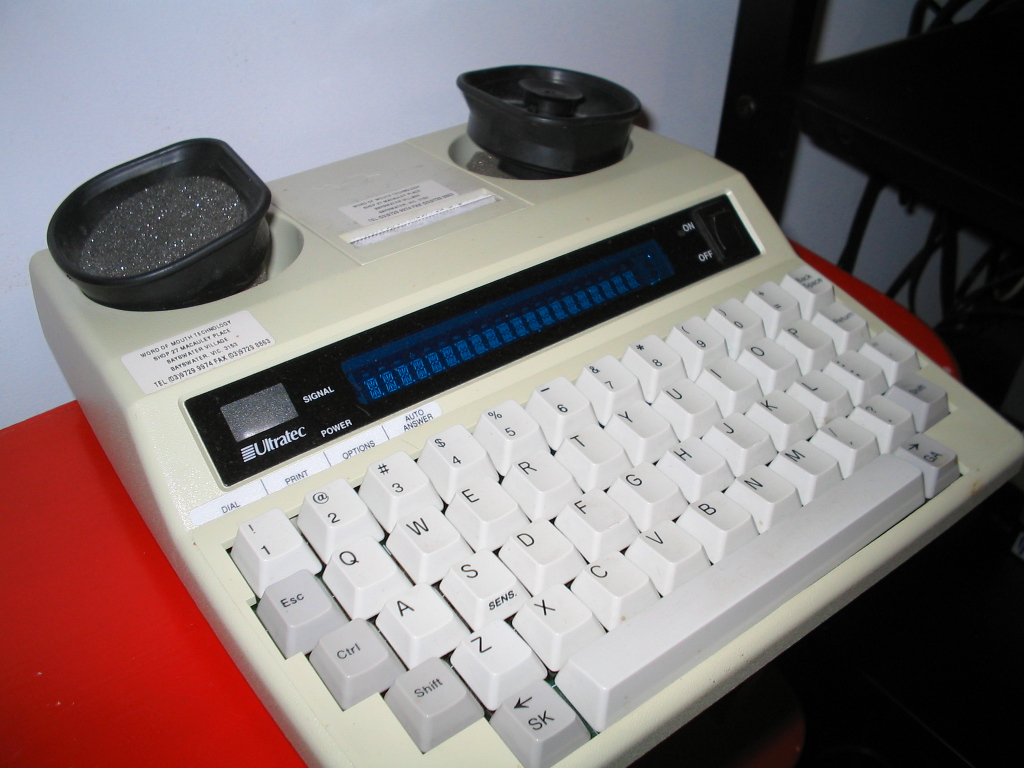
A Miniprint 425 TDD device. Note the acoustic coupler on top,  the VFD for displaying messages, the printer, and the SK and GA keys which automatically key in these regularly-used abbreviations. Credit: public domain

The early machine used simple frequency-shift keying to encode the characters of the alphabet and some basic control codes, allowing text messages to be sent back and forth via a regular analog telephone call. In the US, where the devices eventually became known as telecommunications device for the deaf (TDDs), the devices used an improved development of Baudot code (the USA-TTY variant of ITA-2) to send signals over the phone lines.

This involved representing characters with five bits, which was enough to cover the 26 characters of the English alphabet, plus 0-9 and a few control codes. Transmission rates were slow—typically just 45.5 to 50 baud. With a 5-bit code, this limited transmission to approximately 10 characters per second.

The sign on the left indicates a payphone with a TTY device attached. These were rare installs back in the landline era, and vanishingly few remain today. Credit: CC BY-SA 4.0

TTYs quickly caught on as a useful device for the deaf and hard of hearing, and developed its own norms similar to other textual telecommunications methods that came before. Users would key “GA” for “go ahead,” to indicate the other party could “speak” on the half-duplex link, as two users typing at the same time would lead to garbled messages. “SK” stood for “stop keying” to indicate the ending of a call. Abbreviations were common to save effort, such as “CU” (see you) and “TMW” (tomorrow).

Relay Service

At its heart, the TTY was a very useful device for allowing its users to communicate via textual means to others with compatible hardware. However, alone, a TTY could not allow a deaf user to communicate effectively with regular telephone users. To enable greater accessibility, many organizations developed telecommunications relay services.

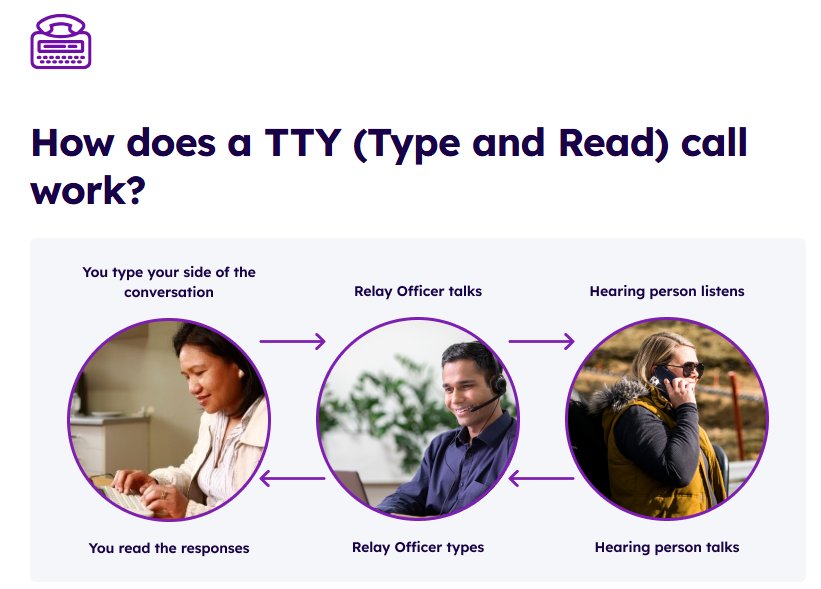
TTY machines led to the establishment of relay services that allowed deaf users to make regular phone calls with assistance from an operator. Credit: screenshot, Australian National Relay Service

These first existed as a number that deaf TTY users could call in order to connect to a human operator with their own TTY machine. This operator would place calls on behalf of the deaf individual, speaking on their behalf to other parties based on the deaf user’s inputs to their TTY device. In turn, the operator would key out the responses from the called party so the deaf individual could read back the conversation.

The first relay service was established by Converse Communications in Connecticut in 1974. The concept was quickly picked up by many other telecommunications operators around the world to provide an accessibility aid to those who needed it. These days, relay services still exist, though a great many relay services now operate over IP-based systems rather than via phone lines and TTY devices.

Hanging On

TTY still exists to some degree out in the world today. There are still subscribers with analog phone lines, and the basic TTY technology still fundamentally works over these links. However, the rise of SMS text messaging and widespread Internet connectivity have somewhat negated a lot of use cases for TTY technology these days. There have also been cases where digital upgrades to the phone network have made TTY operation more difficult, though some efforts have been made to ensure compatibility in some networks, particularly for emergency uses.

Ultimately, TTY was a technology that brought telecommunications access to a greater number of people than ever before. Like the landline phone and the fax machine, it’s no longer such a feature of modern life. However, it was an important link to the world for many in the deaf and hard of hearing community, and was greatly valued for the connection and accessibility it provided.

Network Scanner Finds Every Raspberry Pi

30 Abril 2026 at 05:00

DHCP is great for getting machines on the network with a minimum of fuss. However, it can also make remote administration a pain because you never know which IP you’re supposed to be SSHing into. [Philipp] ran into this problem quite often, so decided to whip up an app to make things easier. 

At it’s heart, the app is a simple network scanner—of which many already exist. However, [Philipp] had found that many options on Android were peppered with ads that made them highly undesirable to use. Thus, he whipped up his own, with a particular eye to working with the Raspberry Pi. It’s not uncommon for a hacker to have a few scattered around the home network, and it can be a real chore keeping track of where they all end up in IP land. The scanner can specifically single out the Raspberry Pi boards on the network via MAC-OUI and mDNS detection. Plus, just in case you need it, [Philipp] threw in some GPIO pinouts and electronics calculators just to make the app more useful.

If you’ve been looking for an open-source network scanner without all the ugly junk, this project might just be for you. You can also check out the source over on Github if that’s relevant to your interests. We’ve seen some interesting custom network scanners before, too. If you’re whipping up some fun packet-flinging software of your own, don’t hesitate to notify the tipsline!

Noctua Releases 3D Models, But Please Don’t Try To Dupe The Products

29 Abril 2026 at 11:00

Noctua wants to make life easier for fans of its…fans. To that end, the company has released a bevy of 3D models across its various product lines, all available to download for free.

If you’re not familiar with the company, Noctua specializes in high-quality cooling systems for the PC market. Its hope is that by freely providing 3D models of its components, it will aid aftermarket companies and DIYers that wish to integrate Noctua fans into their gear. In the company’s own words, these files are made available for “mechanical design, rendering, or animations.” They will let people check things like mountings and fitment without having to have the parts on hand, or to create demo visuals featuring the company’s products.

Don’t get too excited, though, because Noctua has already thought ahead. The company has specifically noted these parts aren’t intended for 3D printing, and critical components like fan blades have modified geometry so as to not compromise the companies IP. You could try and print these models, but they won’t perform like the real thing, and Noctua notes they shouldn’t be used for simulation purposes either. They’re intentionally not accurate to what the company actually sells in that regard.

That isn’t to say Noctua is totally against 3D printing. They have lots of parts available on Printables that they’d love you to try—everything from fan grilles to ducts to anti-vibration pads. Most are useful accessories—the kind of little bits of plastic that make using the products easier—that don’t threaten Noctua’s core product line in the marketplace.

If you’re whipping up a custom PC case and you want to kit it out with Noctua goodies, these models might help you refine your design. It’s funny how it’s such an opposite tactic to that taken by Honda, in terms of embracing the free exchange of 3D models on the open Internet. It’s a move that will surely be appreciated as a great convenience, and we’d love to see more companies follow this fine example.

Thanks to [irox] for the tip!

Compact VGA Output Board For The Pi Pico

29 Abril 2026 at 05:00

Many microcontrollers can spit out simple analog video signals if that’s something you desire. However, it normally requires a bit of supporting hardware and, of course, the right connectors to work with your other video equipment. [Arnov Sharma] took that into account when whipping up this neat VGA board for the Raspberry Pi Pico.

VGA output in this case is achieved via judicious use of the Pi Pico’s PIO subsystem, which is perfect for clocking out the signals for red, green, and blue along with HSYNC and VSYNC as needed. The Pico slots right into [Arnov’s] custom PCB, which makes it a cinch to hook everything up. Supporting hardware is minimal, requiring just a few resistors between the Pico and the DE-15 VGA connector. There’s also a nice LM317 regulator on board to supply power to everything. [Arnov] also whipped up a modified version of the VGA library from [Pancrea85], which allows the Pico to output VGA in a way that’s more accepted by more recent TFT displays as well as older CRTs. The system is demoed with a few basic Hello, World programs, as well as a neat recreation of Conway’s Game of Life.

If you want to get a Pi Pico hooked up to a big screen quickly, whipping up a board like this is a great way to go. If you’re wanting something more advanced, though, you could always explore DVI and HDMI on the same platform. Video after the break.

Payphone Tag Is Australia’s New National Sport

28 Abril 2026 at 20:00

Australia’s payphones are an iconic part of the national landscape, even if they’re not as important as they once used to be. However, they’re having a resurgence of late, in part thanks to a new national pastime—the sport of Payphone Tag!

Created by [Alex Allchin], the game is simple. To play, you first sign up on the website and get your emoji and 5-digit PIN. You then go out and find a payphone, dial the Payphone Tag number, and enter your PIN when prompted. This lets you “capture” the phone, raising your score in the game. If a phone is already captured, no matter—just head out there, dial the number, and key in your own PIN to steal it. You can also push your score even higher by capturing three payphones in a triangle on the map to get bonus points.

It’s a fun geospatial game that’s also free to play, because Telstra made payphone calls free back in 2022. It might cost you a bit to get out to some phones, but there are plenty you can reach with the aid of free public transport at the moment, anyway. Protip—at the time of writing, there are a ton of easy captures to be had on Kangaroo Island. It might just cost you a pretty penny to get out there. Have at it!

We’d love to see some stats from Telstra as to whether this is making a dent in overall payphone usage rates. In any case, there were 800 players in the last 7 days and a full 36,640 captures so far, so a lot is happening out there. We fully expect to see this concept spread to other nations in turn, though it might be less attractive in places where you still need to dig out a coin to make a call.

We’ve featured a few payphone hacks over the years. If you’re doing something rad with these telecommunication devices of yesteryear, we’d love to hear about it on the tipsline.

New Slicer Enables Horizontal Overhangs Without Support

28 Abril 2026 at 11:00

There’s a rule of thumb when it comes to FDM printing that overhangs are really only possible to an angle of around 45 degrees or so. If you try to squirt out plastic with nothing supporting it, it just goes everywhere. However, a new slicer hopes to enable printing up to 90-degree overhangs with some creative techniques.

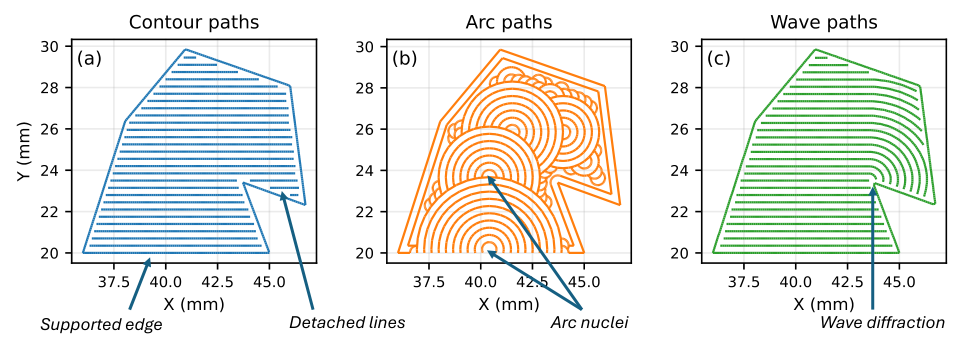
The software that enables this is called WaveOverhangs, and currently exists as a fork of OrcaSlicer. The idea is straightforward enough — using unique toolpathing to create rings of deposited material that fasten to those laid down before them in the same layer. Thus as the printer lays down a layer into bare space, the deposited plastic is, ideally, able to fix on to the supported edge. As the next ring is laid down, it grabs on to the cooled ring laid down before it, and so on. The idea is inspired by wave propagation, hence the name. You can see a demonstration of the software in the video below by [Cocoanix 3D Printing].

It’s still a very new technique. The slicer has a whole bunch of knobs to turn and two different algorithms. Get the settings just right and you can print horizontal overhangs successfully. There aren’t exactly presets yet, this is something to explore with trial and error. If you test it out, don’t forget to upload your results to the Community Gallery so the developers can see what works and what doesn’t.

We’ve explored how smart slicers can do amazing things before, too, particularly when it comes to things like bridging.

Sega Master System Controllers, Now With USB C

28 Abril 2026 at 05:00

USB wasn’t even a gleam in an engineer’s eye when the Sega Master System hit the market in 1985. Today, we’re up to USB 4 or something, and the USB C connector is becoming a defacto standard for just about everything except desktop computers. [Retrostalgia] is embracing this by mating the control pad from Sega’s first international console with the connector of today.

Naturally, the Sega Master System did not use the Universal Serial Bus to talk to its controllers, so some conversion was in order. That’s achieved with the use of a RP2040 microcontroller, which reads the D-pad and action buttons via its GPIO pins. It then acts as a HID device when plugged into a computer or other USB host, showing up as a simple game controller. This is a particularly easy hack as the Master System controller is so simple, there’s no need to decipher any protocols or anything like that. It’s just about wiring up a few simple buttons. Beyond that, it’s just a matter of hot-gluing the RP2040 into the Master System controller housing, and making some room for the USB C port to sneak out the top. We’d have loved to seen a little extra hackery on this one, perhaps adding some rumble to a controller that was never, ever supposed to have it.

If you want to adapt authentic old controllers to work with modern computers and emulators, this project is a great place to start. It doesn’t get much simpler than the Master System, after all. You can always work your way up to more advanced feats later, like working with the beloved Wavebird. Video after the break.

❌
❌